
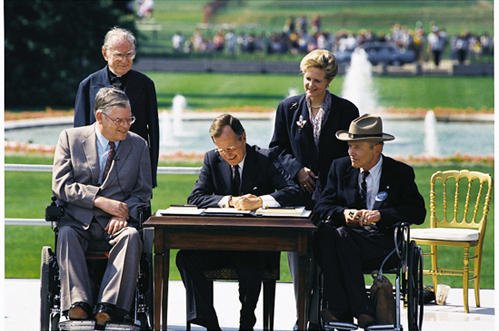
The ADA was not without its opposition — and from very shocking places. The Association of Christian Schools International (!) decried it, saying the ADA labeled religious institutions as “public accomodations” and would require their places of worship to make costly accessibility accomodations. Similarly, the National Association of Evangelicals (!) called it an improper intrusion of the Federal government for providing protections for hiring practices of Disabled workers.
Beyond the religious, the ADA also endured criticism from Greyhound Bus lines, the US Chamber of Commerce, and the National Federation of Independent Businesses all claimed it would be “an expensive headache to millions” and “a disastrous impact on many small businesses struggling to survive.”
My hope is that those who led such opposition have realized they were on the wrong side of history and have softened their heart to such important pieces of social justice legislation.
When President Bush signed the ADA into law on July 26, 1990, he made the following remarks:
“I know there may have been concerns that the ADA may be too vague or too costly, or may lead endlessly to litigation. But I want to reassure you right now that my administration and the United States Congress have carefully crafted this Act. We’ve all been determined to ensure that it gives flexibility, particularly in terms of the timetable of implementation; and we’ve been committed to containing the costs that may be incurred…. Let the shameful wall of exclusion finally come tumbling down.”
That is what a President should sound like.
Thank you to Patrisha Wright, the blind activist we called the General for marshalling the campaign to lobby for the ADA. Thank you to Justin Whitlock Dart, Jr and the honorable Senator Tom Harkin (D-IA) for the final authorship of this landmark bill.
 Jawn-ish